
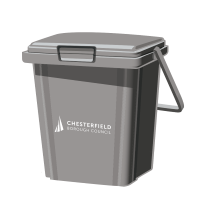
Your grey caddy is for food waste only, and is emptied every week.
 From April 2026 food waste is no longer recycled in green garden waste bins.
Only compostable caddy liners displaying the seed logo and the EN13432 standard are accepted.
Yes please:
- baked goods - such as bread, cake, biscuits
- beans and pulses
- coffee grounds and tea bags (including the bags)
- dairy products - cheese and yoghurts
- eggs and egg products (including egg shells)
- fish and shellfish - raw and cooked, (including bones and shells)
- fruit, vegetables and salad - raw and cooked
- pasta and rice
- lard and other hard fats
- meal or pet food leftovers
- meat - raw and cooked (including bones)
- pasta, rice and grains
No thanks:
- ashes
- cardboard
- foil
- garden waste
- glass
- liquids
- newspaper
- packaging or containers of any sort
- plastic film or plastic bags
- sawdust, straw, animal bedding or pet waste
- any other recycling or waste
Too much food waste for your caddy?
Don't put out extra food waste recycling alongside your caddy, please save it until the next weekly collection.
If you regularly produce too much food waste you can request an extra caddy by calling our contact centre on 01246 345734.
The additional food caddy will be delivered to you free of charge.
Food waste recycling began in April 2026.
This service has been introduced as part of new Government legislation, which requires councils across England to offer weekly food waste collections.
Food waste caddies were delivered to each household ready for the first collection - if you haven't received yours please call our customer services team on 01246 345734.
Food waste is recycled in a grey 23-litre caddy - this is roughly the size of a medium pedal bin or a standard rucksack.
You do not have to use a bag inside your food caddy, but you can if you want to.
If you do use bags, they must be compostable and clearly display:
- the EN13432 standard
- the compostable seed logo
We do not supply bags, but compostable bags can be purchased from many supermarkets or online.
Food waste is collected weekly by dedicated food waste vehicles. You can check your collection day on My Chesterfield.
Please put your food caddy at the boundary of your property by 7am on your collection day, the same as you do for your wheelie bins.
If you have assisted bin collections we will also collect your food caddy for you, there's no need for you to put it out yourself.
If you miss your collection, we will not be able to return - your food waste will be collected on your next scheduled collection day.
No - only food waste placed inside the caddy will be collected.
If you regularly produce more food waste, you can request an additional caddy free of charge by calling our contact centre on 01246 345734.
Yes - if you find one caddy is not enough you can request an additional food caddy by calling our contact centre on 01246 345734.
The additional food caddy will be delivered to you free of charge.
Yes - when the handle is in the upright position, the container is secured and cannot be opened by animals.
To help prevent smells or pests:
- put food waste out for collection every week
- use compostable liners if you wish
- keep the caddy lid closed
- rinse the caddy occasionally with clean water
You can request a replacement by:
- logging into your My Chesterfield account
- calling our contact centre on 01246 345734
The replacement food caddy will be delivered to you free of charge.
We encourage all residents to give food waste recycling a try, as it helps to reduce waste going to landfill.
All households will receive a food waste caddy as part of the new legal requirement - we won’t be collecting or removing unwanted bins.
Yes - you can compost your food waste at home instead if you wish.
If you are unable to put your bin out yourself and there is no one in your household aged 16 or over who can help, you may qualify for an 'assisted collection' - find out more here.
If you already receive assisted collections, your food waste caddy will be collected in line with your current arrangements.
Food waste collections for communal properties will be introduced later in 2026.
Residents will be contacted in advance with further information.
Food waste is taken to a specialist treatment facility, where it is recycled rather than sent to landfill.
It is processed through anaerobic digestion, where it is broken down to produce:
- biogas, which can be used for energy
- biofertiliser, which is used on farmland
Yes - food waste collections are free of charge for residents.
No - introducing food waste collections does not mean your Council Tax has been increased.
It is a central government requirement for food and garden waste to be collected separately.
Food waste is processed through anaerobic digestion or in-vessel composting.
Garden waste breaks down differently and cannot go into the food waste caddy, as this would contaminate the food only collection.